Stochastic Numerics and Statistical Learning: Theory and Applications Workshop 2026 Nov 22, 08:30 - Dec 2, 13:30 B2/3 A0215 Workshops stochastic algorithm numerical analysis statistical learning Bringing together experts in stochastic algorithms, numerical analysis and statistical learning with applications in climate modeling and quantitative finance.
Nonlinear Optimal Control and Filtering beyond the HJB Equation Alessandro Astolfi, Professor, Applied Mathematics and Computational Science Nov 19, 12:00 - 13:00 B9 R2325 nonlinear optimal control optimal control Filtering theory PDEs non-linear feedback A novel set of sufficient conditions - equivalent to the HJB equation for the solution of nonlinear optimal control problems.
Mathematical and Computational Models of Fluid-Solid Interactions in the Subsurface Maryam Alghannam, Ibn Rushd Assistant Professor, Earth Systems Science and Engineering Nov 12, 12:00 - 13:00 B9 R2325 computational models fluid dynamics computational fluid dynamics
Polytopal Element Methods In Mathematics and Engineering (POEMS) 2026 Nov 9, 20:00 - Nov 12, 17:00 KAUST polytopal elements virtual elements Discontinuous Galerkin POEMS 2026 will convene international researchers in numerical methods for PDEs at KAUST.
Bayesian Decision-Theoretic Privacy Christian P. Robert, Full Professor, Department of Applied Mathematics (CEREMADE), Paris Dauphine-PSL University; Nov 2, 12:00 - 13:00 B3 R5209 Data Privacy statistical privacy bayesian adversial privacy privacy-preserving machine learning privacy-preserving AI bayesian methods This seminar introduces two Bayesian decision-theoretic frameworks, persuasive privacy and Bayesian adversarial privacy, that quantify statistical privacy by evaluating how data releases influence adversarial beliefs and decisions while offering contextual alternatives to conventional differential privacy.
On the Difficulties of Assessing Statistical Privacy Christian P. Robert, Full Professor, Department of Applied Mathematics (CEREMADE), Paris Dauphine-PSL University; Nov 1, 12:00 - 13:00 B9 R2325 Bayesian Statistics statistical privacy privacy bayesian adversial privacy This distinguished lecture examines the limitations of statistical disclosure control and differential privacy and explores robust, deliberately insufficient statistics combined with Bayesian inference as an alternative approach to protecting individuals in shared data.
Saudi HPC/AI Conference 2026 Oct 26, 08:00 - Oct 28, 17:00 KAUST HPC AI big data Data Analytics machine learning artificial intelligence Join researchers, technology experts and industry leaders to explore how HPC and AI are advancing research and innovation.
Reading Theorems in Lean Diogo Gomes, Associate Dean for Students, Computer, Electrical and Mathematical Sciences and Engineering Oct 22, 12:00 - 13:00 B9 R2325 proof assistant Computational mathematics Applied Machine Learning mathematics mathematical modelling This seminar introduces the Lean proof assistant from the perspective of reading and auditing mathematical statements, exploring its role in auto-formalization and its capacity to expose tacit assumptions in mathematical research.
Diogo Gomes, Associate Dean for Students, Computer, Electrical and Mathematical Sciences and Engineering
Solvers That Don't Choose Sides Esmail Abdul Fattah, Postdoctoral Research Fellow, Statistics Oct 15, 12:00 - 13:00 B9 R2325 sparse computation scientific computing programming abstractions dense linear algebra Sparse Linear Algebra sTiles In this talk, I will present sTiles, a direct solver that decides sparse or dense tile by tile instead of once for the whole matrix, covering the full range from sparse to fully dense and outpacing established sparse direct solvers on the repeated factorizations that drive large-scale inference.
Unbiased and Multilevel Monte Carlo Methods for Parameter Inference in Latent Stochastic Systems Miguel Angel Alvarez Ballesteros, Ph.D. Student, Applied Mathematics and Computational Science Oct 14, 11:00 - 13:00 B2 R5209 Monte carlo methods Monte Carlo stochastic optimization markov chains approximation This thesis develops efficient Monte Carlo methods for score-based parameter inference in such systems, mainly hidden Markov models driven by diffusion processes, and for the related problem of conditional stochastic optimization.
Approximate Bayesian inference for structural equation models Haziq Jamil, Research Specialist, Statistics Oct 8, 12:00 - 13:00 B9 R2325 Laplace approximation Bayes estimators copulas R This talk reviews a fast approximate Bayesian SEM method that combines Laplace, variational Bayes, and Gaussian copula techniques to deliver near-MLE speed with MCMC-like inference, and is implemented in the R package INLAvaan.
Finite Element Approximation of Fluid-Structure Interaction Problems Fabio Credali, Postdoctoral Research Fellow, Applied Mathematics and Computational Science Oct 1, 12:00 - 13:00 B9 R2325 finite element method approximation fluid dynamics Computer simulations We review the main strategies for the finite element approximation of fluid-structure interaction problems and then focus on one of them, the fictitious domain method, analyzing its formulation and convergence properties.
Physics-Informed Spatiotemporal Surrogate Modeling and Robust Operational Optimization for CO₂ Applications in Subsurface Flow under Permeability Uncertainty Zhao Beichen, Visiting Student, Applied Mathematics and Computational Science Sep 17, 12:00 - 13:00 B9 R2325 Physics-informed Neural Networks Deep learning numerical simulations uncertainty quantification subsurface fluid flow This talk presents a physics-informed spatiotemporal surrogate that predicts coupled CO₂ storage and geothermal responses under geological uncertainty and enables rapid, risk-aware optimization of staged well controls.
NVIDIA Days at KAUST Sep 15, 20:45 - Sep 17, 17:00 B2/3 A0215 HPC NVIDIA agentic AI systems Physical AI digital twins robotics weather GPU quantum computing Join us (registration required) for the KAUST Supercomputing Lab (KSL) NVIDIA Days from September 15 to 17, 2026, a three-day program supporting the community's ongoing work in AI and High Performance Computing (HPC) through expert-led sessions, personalized clinics, and hands-on training.
Threshold Dynamics and Delayed Closure in a Moving-Boundary Model of Epidermal Wound Healing Zhang Zhiwen, Postdoctoral Research Fellow, Applied Mathematics and Computational Science Sep 10, 12:00 - 13:00 B9 R2325 healthcare technologies numerical analysis analytical tools numerical simulations healthcare analytics We analyze how growth-factor production, diffusion, decay, activation thresholds, and wound geometry interact to determine whether epidermal wound closure begins, proceeds continuously, experiences repeated delays, or stops before completion.
The Event Horizon Telescope: From the First Images to the First Movies of Black Holes Laurent Loinard, Professor of Astronomy, Institute for Radio Astronomy and Astrophysics (IRyA), National Autonomous University of Mexico (UNAM) Sep 7, 16:00 - 17:00 B20 Auditorium Astrophysics Visualization High Performance Computing algorithms telescope statistical inference computational analysis galaxy black holes astrometry This lecture explores the Event Horizon Telescope's groundbreaking achievements in imaging supermassive black holes, details the complex global and computational infrastructure enabling these discoveries, and outlines the future transition from static images to dynamic, real-time movies of the universe's most extreme environments.
Geospatial Data Science for Public Health Surveillance Paula Moraga, Associate Professor, Statistics Sep 3, 12:00 - 13:00 B9 R2325 geospatial data analysis health monitoring spatio-temporal disease data climate data health policy This talk will provide an overview of statistical methods and computational tools for geospatial health data analysis and disease surveillance, with a focus on forecasting climate-sensitive diseases, the integration of health, climate, and digital data, and their role in informing public health policy.
Stochastic Optimal Control with Applications to Renewable Energy and Partially Observed Systems Eliza Rezvanova, Ph.D. Student, Applied Mathematics and Computational Science Aug 6, 15:00 - 17:00 B5 R5209; Zoom Meeting 4569553742 Partially Observed Stochastic Optimal Control Stochastic Optimal Control renewable energy Dynamic programming This thesis develops continuous-time dynamic programming frameworks and shows how dynamic programming and HJB methods can be extended to settings that do not satisfy the classical Markovian and full-observation assumptions through appropriate relaxation and state-reformulation techniques.
Gray Scott School 2026 Jun 29 - Jul 2, All day B3 L2 R2202 HPC Performance optimization parallel computing Join an international training program focused on GPU computing and HPC technologies.
Theoretical Foundations of Communication-Efficient, Robust, and Practical Distributed and Federated Optimization Grigory Malinovsky, Ph.D. Student, Applied Mathematics and Computational Science Jun 18, 15:45 - 19:00 B5 R5209 machine learning Federated learning distributed optimization applied statistics This thesis investigates seven critical challenges at the intersection of theory and practice, specifically focusing on the fundamental bottlenecks of Federated Learning and distributed optimization and develops novel algorithmic frameworks that provide sharp theoretical guarantees to bridge the gap between heuristic success and mathematical rigor.
Time Series Clustering: Pattern Recognition, Forecasting, and Amortized Inference Ángel López Oriona, Postdoctoral Research Fellow, Statistics May 14, 12:00 - 13:00 B9 R2325 Time Series Pattern Recognition forecasting statistical inference This talk presents innovative time series clustering techniques, highlighting a quantile-based approach for analyzing locally stationary data, a predictive framework for enhanced forecasting, and the use of amortized inference to overcome traditional algorithmic limitations.
Stability and Signal Generator Agnostic Moment Matching Alessandro Astolfi, Professor, Applied Mathematics and Computational Science May 10, 14:30 - 15:30 B1 R3119 moment matching model reduction interpolation Stability This talk explores advancements in model reduction that modernize traditional moment matching by introducing a data-driven procedure for unknown signal generators and a closed-loop interpolation framework that extends these techniques to unstable systems.
Fully Decentralized Inference for Spatial Data Using Low-Rank Models Jianwei Shi, Postdoctoral Research Fellow, Statistics May 7, 12:00 - 13:00 B9 R2325 statistical inference decentralized systems Geospatial Data geospatial statistics optimization This talk introduces a novel, fully decentralized optimization framework to enable scalable parameter inference in large spatial low-rank models, supported by both theoretical guarantees and empirical validation.
Event Status: Cancelled | Robust and Fuzzy Methods for High-Dimensional Time Series Clustering and Forecasting Ziling Ma, Ph.D. Student, Statistics Apr 30, 12:00 - 13:00 B9 R2325 These talks introduce several robust methods for clustering and forecasting multivariate time series data.
Mathematical Modeling and Analysis of Liquid Crystals: Ericksen-Leslie Model Majed Sofiani, Postdoctoral Research Fellow, Applied Mathematics and Computational Science Apr 27, 14:00 - 15:00 B1 R3426 Ericksen-Leslie Model non-linear partial differential equations Liquid Crystals Navier-Stokes equation This talk I will provide an overview of the celebrated Ericksen-Leslie model for nematic liquid crystals.
Dynamical Systems in Data Science: From Kinetic Closure to Learning Dynamics Dr. Florian Kogelbauer, Senior Research Fellow, Swiss Federal Institute of Technology Zurich (ETH Zurich) Apr 27, 12:00 - 13:00 B2/3 A0215 This talk explores two ways in which ideas from dynamical systems can shape the mathematics of data science.
Rare-Event Simulation Methods for Outage Probability in GSC/MRC Systems under Rician Fading Mahmoud Hassan Ghazal , Ph.D. Student, Electrical and Computer Engineering Apr 23, 12:00 - 13:00 B9 R2325 Statistics of extremes Outage Probability Applied Probability This talk explores enhanced Monte Carlo (MC) techniques for estimating the OP of SIMO systems under Rician fading, where the selected signals are combined using maximum ratio combining (GSC/MRC).
Efficient Numerical Methods for Scalable Bayesian Inference Lisa Gaedke-Merzhäuser, Postdoctoral Research Fellow, Statistics Apr 16, 12:00 - 13:00 B9 R2325 numerical methods Efficient Bayesian Inversion Automated and scalable algorithms This talk will introduce and discuss the computational building blocks of Integrated Nested Laplace Approximations (INLA) and how these are implemented in software libraries such as R-INLA or DALIA.
Data Analytics to Outcome Impact for Transplantation and Clinical Practice Apr 9, 10:00 - 16:00 B3 R5209 Workshops AI for healthcare Mathematical modeling smart health bioinformatics Data Analytics Leveraging national data analytics and computational tools to advance transplantation and clinical practice.
The Role of Humans in Scientific Discovery in the Age of LLMs — Beyond Asking: Turning LLMs into Research Collaborators Sir Bashir M. Al-Hashimi, Vice President, Research & Innovation, King’s College London (KCL); Distinguished Professor, Department of Engineering, Faculty of Natural, Mathematical & Engineering Sciences, King’s College London (KCL) Apr 8, 12:00 - 14:15 B9 R2325 AI artificial intelligence LLM scientific research scientific knowledge Assistive Technology Rather than offering definitive conclusions, this talk seeks to stimulate dialogue, question assumptions, and inspire new forms of collective thinking about the future of scientific research and doctoral training in an AI-driven world.
Reduced-Order High Fidelity Simulations of Reacting Flows Using Low Dimensional Manifolds and Machine Learning Hong G. Im, Professor, Mechanical Engineering; Deputy Chair, Clean Energy Research Platform, King Abdullah University of Science and Technology (KAUST) Apr 7, 14:30 - 15:30 B1 R3119 machine learning Applied Machine Learning principal component analysis PCA computational singular perturbation renewable energy flow problems computational simulations This talk will provide an overview of historical developments in mathematical and computational approaches to reduced order models for accelerated high fidelity reacting flow simulations in modern computing hardware.
A Unified Monotonicity Framework for Mean-Field Games Rita A. Ferreira, Research Scientist, Mean-field Games and Nonlinear PDE Apr 2, 12:00 - 13:00 B9 R2325 gamma-convergence asymptotic analysis variational analysis Variational mean-field games In this talk, we discuss how monotone operator methods provide a unified approach to existence, uniqueness, and regularity in MFGs.
Extrapolated Linear Multistep Methods Lajos Lóczi, Research Scientist, Applied Mathematics and Computational Science Mar 12, 12:00 - 13:00 B9 L2 R2325 ODEs PDEs numerical methods linear multistep methods LMMs In this talk, we will discuss how linear multistep methods and classical extrapolation can be combined to obtain new classes of efficient time-integration methods.
Advances in Multiscale Hierarchical Decomposition Methods for Image Restoration Luminita Vese, Professor of Mathematics, University of California, Los Angeles (UCLA) Mar 10, 14:30 - 15:30 B1 L3 R3119; Zoom Meeting 99254591389 This talk will present the multiscale hierarchical decomposition method (MHDM) for image restoration and scale separation, building on the framework introduced by Tadmor, Nezzar, and me.
Mathematical Modelling of Solar Cells Theodoros Katsaounis, Professor, Department of Mathematics and Applied Mathematics, University of Crete (UoC) Mar 10, 11:00 - 12:30 B1 L3 R3119 solar cells Mathematical modeling PDEs numerical PDEs This talk presents the development and the numerical approximation of mathematical models for some well known solar cell architectures.
Event Status: Cancelled | Remote Sensing and Agroinformatics Insights in Saudi Arabia Using Machine Learning Ting Li, Postdoctoral Research Fellow, Environmental Science and Engineering Mar 5, 12:00 - 13:00 B9 L2 R2325 remote sensing machine learning sustainable agricultural agricultural productivity This talk explores how machine learning and high-resolution satellite remote sensing are being used to transform vast amounts of raw data into actionable agroinformatics at a national scale, providing the precision needed to manage these vital resources sustainably.
Approximation and Optimization for Neural Networks Gerrit Welper, Assistant Professor, Mathematics, University of Central Florida (UCF) Mar 4, 16:00 - 17:00 Zoom Meeting 95807131415 Neural Networks optimization deep neural networks Finite element methods In this talk, we consider new connections between the approximation and optimization of neural networks. Instead of relying on excessive over-parametrization to achieve zero training loss, we identify good minima by comparison with established approximation bounds.
Structure Preserving Methods for Schrodinger Type of Equations Theodoros Katsaounis, Professor, Department of Mathematics and Applied Mathematics, University of Crete (UoC) Mar 3, 14:30 - 15:30 B1 L3 R3119 Schrödinger equation cosmology waves This talk presents a class of structure preserving methods for Schrodinger type of equations with applications in the generation of rogue waves and cosmology.
Rigorous Model-Constrained Scientific Machine Learning for Digital Twins: A Computational Mathematics Perspective Tan Bui-Thanh, Professor, Endowed William J. Murray, Jr. Fellow in Engineering No. 4, Oden Institute for Computational Engineering & Sciences, Department of Aerospace Engineering & Engineering Mechanics, The University of Texas at Austin (UT Austin) Feb 26, 14:30 - 15:30 B1 L3 R3119 Scientific Machine Learning SciML Scientific Deep Learning SciDL deep learning machine learning digital twins uncertainty quantification Computational mathematics This talk will outline a principled pathway from traditional computational mathematics to rigorously grounded Scientific Machine Learning (SciML) and present recent Scientific Deep Learning (SciDL) methods for forward modeling, inverse and calibration problems, and uncertainty quantification, emphasizing mathematical structure, stability, and generalization.
Graphpcor: Prior for Correlation Matrices Elias Teixeira Krainski, Research Scientist, Statistics Feb 26, 12:00 - 13:00 B9 L2 R2325 correlation Bayesian Estimation expert knowledge integration This talk introduces a scalable, graph-based framework for modeling correlation matrices that integrate expert-informed priors.
Computing Heteroclinic Orbits for Dynamical Systems Theodoros Katsaounis, Professor, Department of Mathematics and Applied Mathematics, University of Crete (UoC) Feb 23, 11:00 - 12:30 B1 L3 R3119 Dynamical Systems heteroclinic orbits Numerical Modeling This course provides an overview of the most well known methods for computing heteroclinic orbits for dynamical systems.
C1+alpha Regularity for the Fractional p-Laplacian David De Jesus, Postdoctoral Research Fellow, Applied Mathematics and Computational Science Feb 19, 12:00 - 13:00 B9 L2 R2325 Mathematical modeling In this talk, we will discuss a recent result obtained in collaboration with Davide Giovagnoli and Luis Silvestre, where we solve a standing conjecture asserting that, as in the local setting, solutions of the homogeneous equation are still Hölder differentiable.
A Dichotomy of Continuous Finite Element Spaces and Its Application to Energy-Conservative Galerkin Methods for Nonlinear and Dispersive Wave Equations Dimitrios Mitsotakis, Reader/Associate Professor, Engineering Mathematics, School of Mathematics and Statistics, Victoria University of Wellington (VUW) Feb 17, 14:30 - 15:30 B1 L3 R3119 dispersive waves optimization Finite elements This talk illustrates why energy-conservative Galerkin methods for nonlinear and dispersive wave equations achieve optimal convergence rate with odd-degree polynomials.
Data-driven Anomaly Detection in Industrial Processes Fouzi Harrou, Senior Research Scientist, Statistics Feb 12, 12:00 - 13:00 B9 L2 R2325 anomaly detection multivariate statistics artificial intelligence AI This talk presents a model-based anomaly detection framework, along with data-driven process monitoring approaches based on multivariate statistical methods and artificial intelligence techniques.
Mathematical Design and Analysis of Iterative Methods for Linear and Nonlinear Problems Jongho Park, Assistant Professor, School of Science and Engineering (SSE), The Chinese University of Hong Kong, Shenzhen (CUHK-Shenzhen) Feb 10, 14:30 - 15:30 B1 L3 R3119 nonlinear models algorithms iterative methods This talk presents a systematic approach to the design and analysis of iterative methods for solving linear and nonlinear problems.
Jongho Park, Assistant Professor, School of Science and Engineering (SSE), The Chinese University of Hong Kong, Shenzhen (CUHK-Shenzhen)
On the Modeling and Approximation of Phase Transitions in Elasticity Georgios Grekas, Postdoctoral Research Fellow, Applied Mathematics and Computational Science Feb 5, 12:00 - 13:00 B9 L2 R2325 Phase transitions elasticity mathematical modelling This talk explores the mathematical modeling of phase transitions in elasticity, drawing motivation from observed phenomena in crystalline solids and biomaterials.
Energy-Efficient and Sustainable Spatial Modeling Using GPU Computing Sameh Abdulah, Senior Research Scientist, Applied Mathematics and Computational Science Jan 29, 12:00 - 13:00 B9 L2 R2325 HPC This talk highlights recent advances in energy-efficient and sustainable spatial modeling using GPU computing. It focuses on mixed-precision algorithms and scalable spatial statistical modeling that significantly reduce computational cost and power consumption while preserving scientific accuracy.
The Sharpness Condition for Constructing Finite Element From a Superspline Qingyu Wu, Ph.D. Student, Mathematics, Peking University Jan 28, 14:00 - 15:00 B1 L3 R3119 In this talk, I will discuss the sharpness conditions for constructing Cʳ conforming finite element spaces from superspline spaces on general simplicial triangulations and introduce the concept of extendability for pre-element spaces, which unifies both superspline and finite element spaces under a common framework.
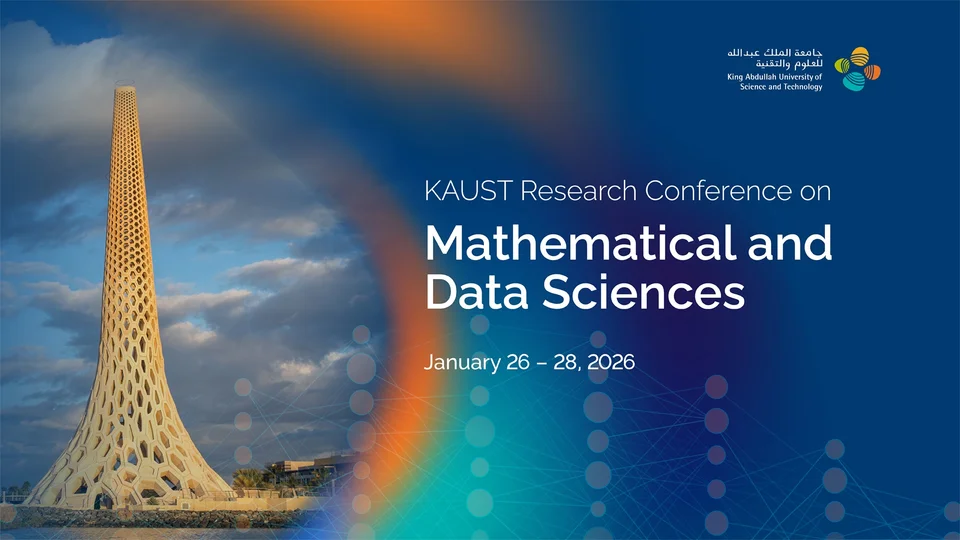
KAUST Research Conference on Mathematical and Data Sciences Jan 26 - 28, All day KAUST Campus data science scientific computing Computer science Theory and applications of data science.
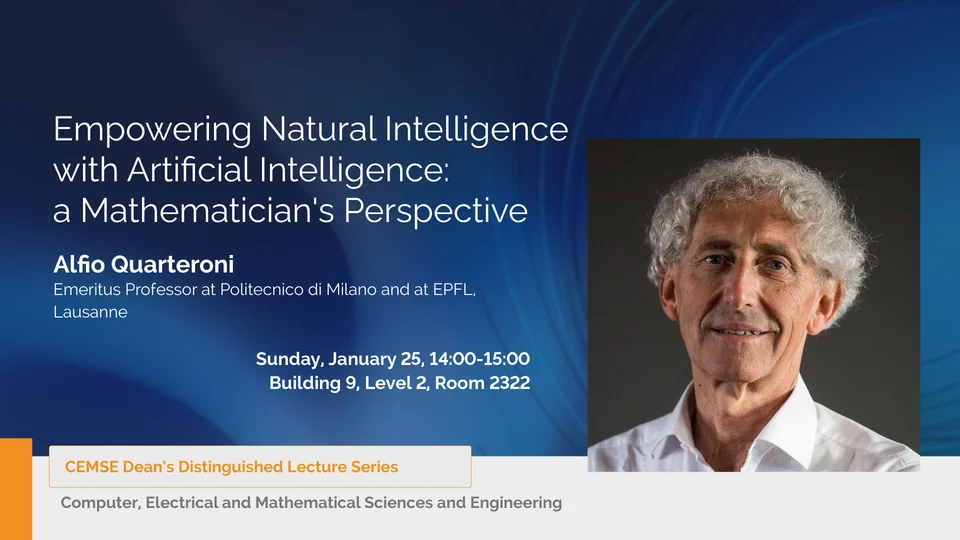
Empowering Natural Intelligence with Artificial Intelligence: a Mathematician's Perspective Alfio Quarteroni, Emeritus Professor, Politecnico di Milano and EPFL Jan 25, 14:00 - 15:00 B9, L2, R2322 Computational mathematics numerical methods Scientific Machine Learning scientific computing applied mathematics A Dean’s Distinguished Lecture on natural intelligence, artificial intelligence and scientific machine learning.